
What Is the Plateist Training Kit?
And How Is It Different from The Plating Gym?
Over the past few weeks, I’ve had a number of messages asking the same thing:
“What exactly is the Training Kit?”
“Is it just a summary of the book?”
“Do I need both?”
Those are fair questions. When you’re investing time (and money) into improving your craft, you want clarity. So this article is a proper explanation, not a sales pitch, but a clear breakdown of what the Plateist Training Kit is, what it contains, who it’s for, and how it differs from The Plating Gym.
Because although they are closely connected, they are not the same thing. They serve different roles in your development as a Plateist.
The Role of “The Plating Gym”
The Plating Gym was written to explore the visual side of food in depth. It dives into colour theory, hierarchy, balance, composition, minimalism, contrast, layout systems such as S.L.I.C., idea generation, common pitfalls, and the psychology of how we experience food visually before we taste it.
At its core, the book is about helping you see differently.
It builds your understanding of why certain plates feel harmonious and others feel chaotic. It explains why colour combinations work, why focal points matter, how negative space changes perception, and how visual weight affects balance. It introduces frameworks like the S.L.I.C. layouts and the C.R.A.P. design principles not as rigid rules, but as tools for clarity.
In many ways, The Plating Gym is the theory, the philosophy, and the mental model behind beautiful plates. It changes your mindset. It expands your awareness. It helps you move from instinct to intention.
But understanding design principles and executing them consistently are two different skills.
That gap, between knowing and doing, is exactly why the Training Kit exists.
What the Plateist Training Kit Actually Is
The Plateist Training Kit is not another book. It’s not a rewritten version of The Plating Gym. It’s not a condensed summary.
It is a practical, structured, working document designed to sit beside you in the kitchen.
If the book explains how plate design works, the Training Kit helps you practise it.
Where the book explores ideas in depth, the Training Kit turns those ideas into repeatable processes. It gives you worksheets, prompts, planning structures, and critique tools that force clarity before you plate. It is deliberately hands-on. It is something you fill in, write on, refer back to, and reuse.
Think of it like this: the book develops your understanding; the Training Kit develops your execution.
The Shift from Inspiration to Structure
One of the biggest issues I see with plating is not a lack of creativity. Most chefs and home cooks are not short of ideas. They are short of structure.
Plating often happens at the end of cooking, when energy is low and time is tight. Decisions become reactive rather than intentional. Garnishes are added because they look “nice.” Sauces are swiped because that’s what we’ve seen before. Negative space is either ignored or accidental.
The Training Kit interrupts that habit.
It slows you down — not in a way that makes service inefficient, but in a way that builds intention before you ever touch the plate.
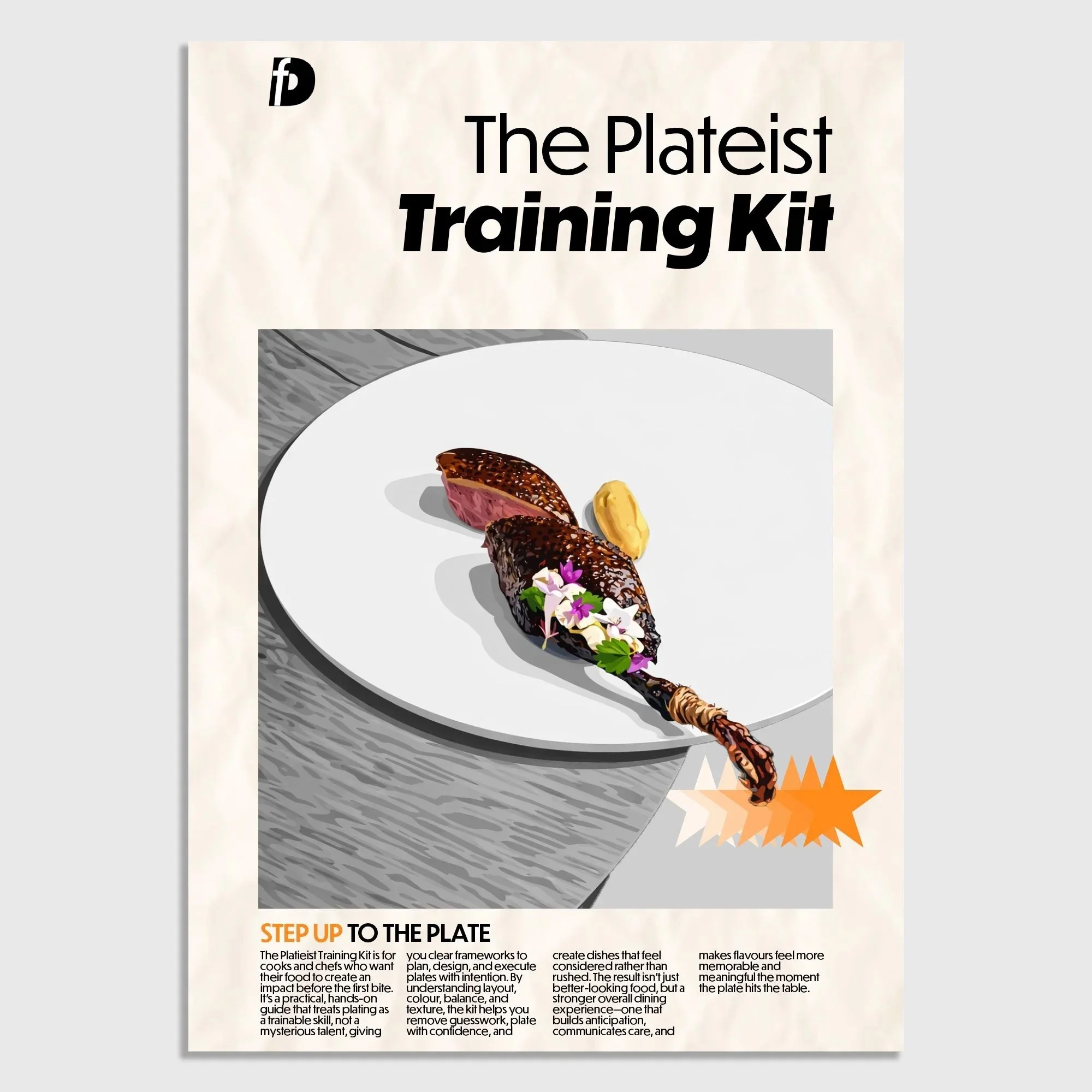
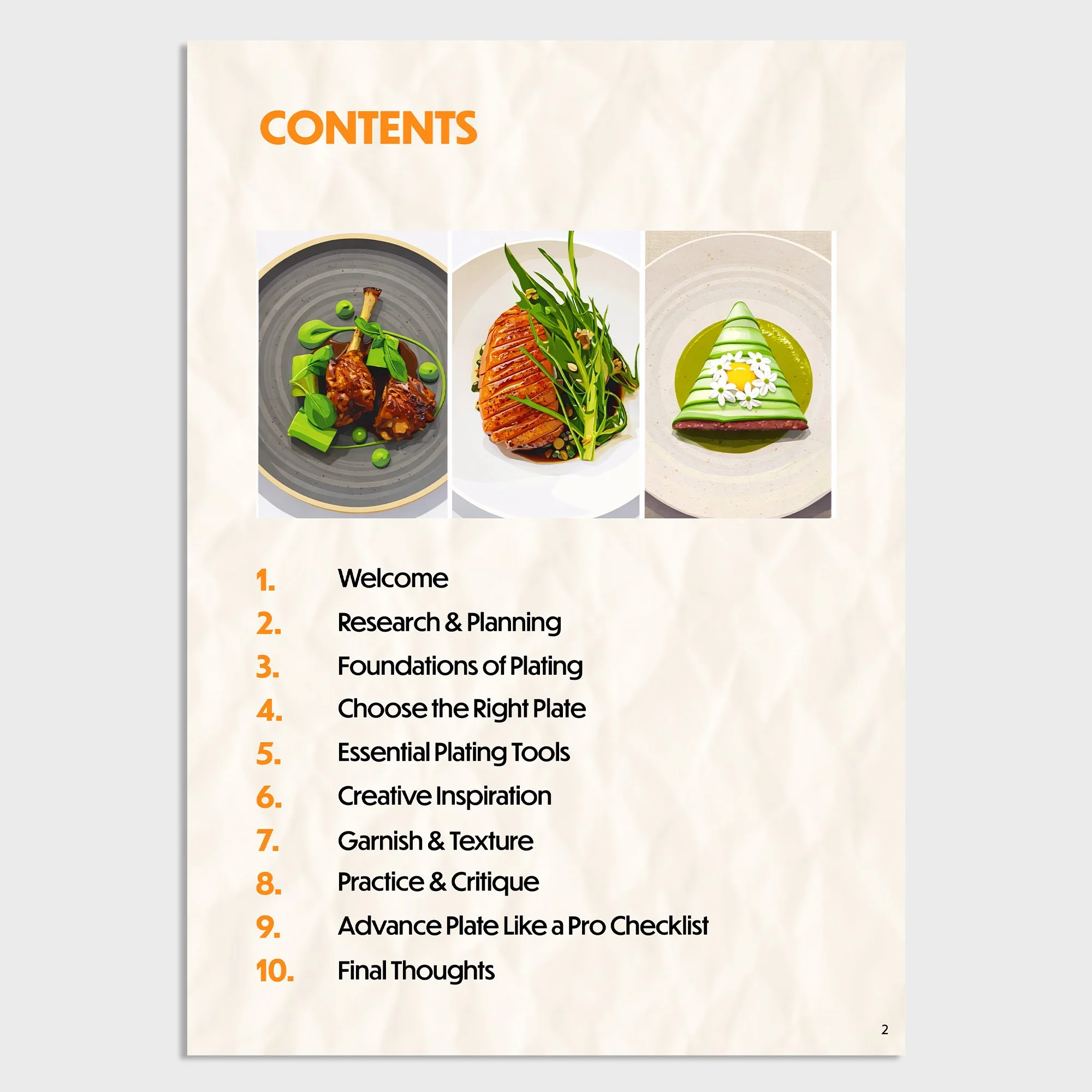
The Plating Training Kit is a practical, step-by-step collection of worksheets, planning tools, and visual checklists designed to help chefs and cooks design better plates with intention. It gives you a clear process for researching ideas, planning layouts, using colour and garnish purposefully, and critiquing your own work—so your food doesn’t just taste good, it looks considered, confident, and consistent.
If you want to understand the thinking behind these tools, bundle it The Plating Gym – Hardback or Digital Edition. When both are added to your basket, 50% is automatically taken off The Plateist Training KIt at checkout, making this the easiest way to learn the principles and put them into practice at the same time.
Research Before Plating: Building Your Visual Library
One of the foundational ideas in the kit is that plating begins long before the food hits the plate. The Research & Planning section introduces the concept of a swipe file and a visual library. Instead of passively scrolling through Instagram and admiring dishes, you actively analyse them.
What is the layout?
Where is the focal point?
How does the colour palette create mood?
Is the plate minimalist or abundant?
How does texture create contrast?
The “Train Your Eye” worksheet takes this even further. It helps you break down dishes systematically, identifying layout style, colour harmony, texture contrast, negative space, mood, and the role of the plate itself.
Over time, this builds a sharper visual instinct. You stop copying. You start interpreting.
Planning Before You Plate
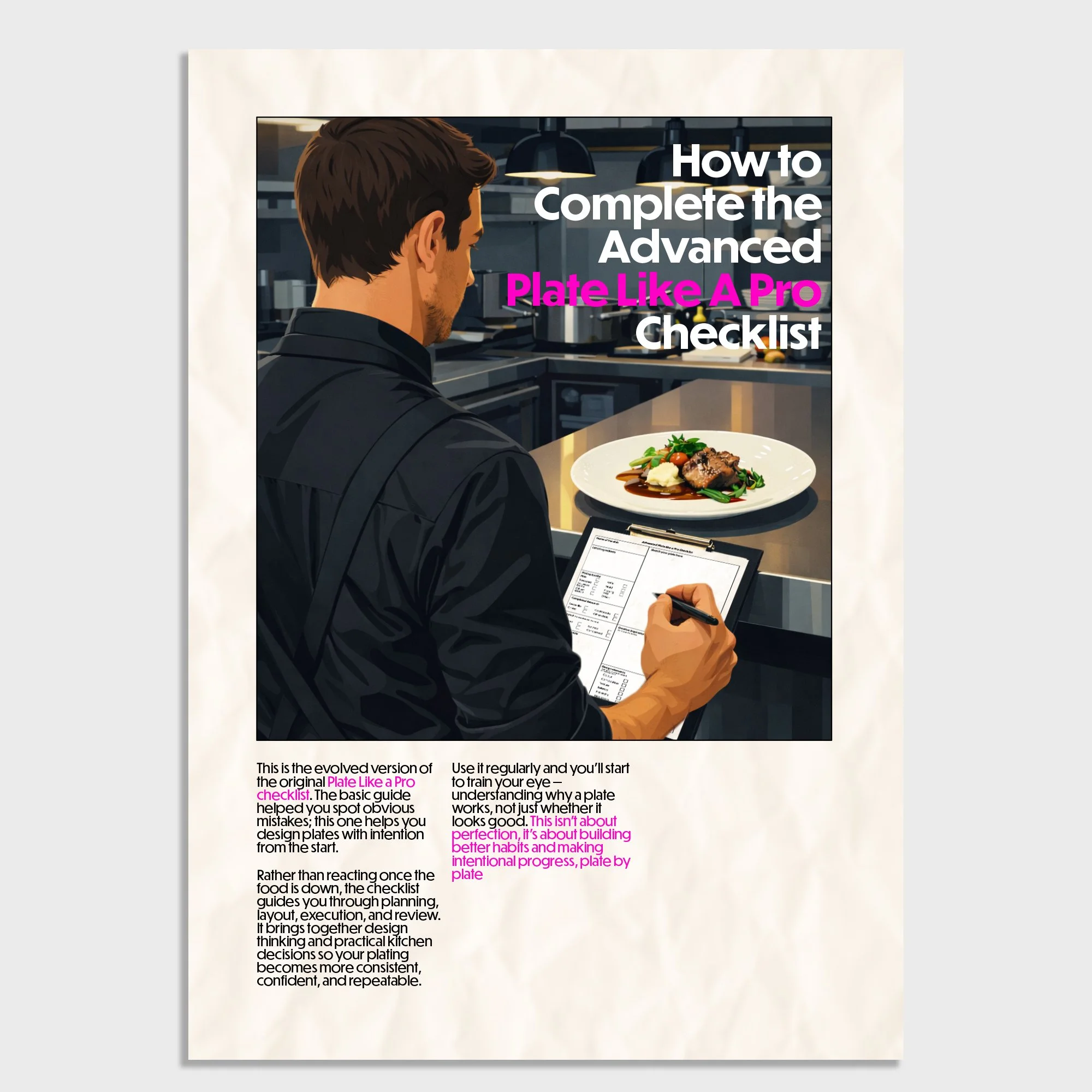
One of the most powerful tools in the Training Kit is the Advanced Plating Planner. This isn’t about writing recipes. It’s about designing plates.
Before plating, you define the dish and its theme. You list your mise en place — not just what’s cooked, but what will physically be placed. You select a layout style (Stacked, Linear, Isolated, Condensed) and consciously decide how the diner’s eye should move.
You then map out your “hits to the plate” — each individual placement step, in order. This simple act transforms plating from guesswork into choreography. You know what goes down first. You know what must be placed last because of temperature. You understand which elements anchor the composition and which ones finish it.
You sketch the plate from a top-down perspective. You consider colour, texture, hierarchy, balance, negative space, height, scale, and lines before the plate exists physically.
It forces intention.
Instead of improvising under pressure, you execute a plan.
Foundations, Distilled for Practice
While The Plating Gym explores design theory in depth, the Training Kit provides a distilled, practical refresher. The S.L.I.C. layouts are explained in a concise, actionable way. Balance is broken down into symmetrical, asymmetrical, and radial in terms you can apply immediately. Colour strategies are simplified into usable approaches — complementary, analogous, monochrome, warm vs cool.
It’s not there to inspire you. It’s there to guide you.
Garnish and Texture: Moving Beyond Decoration
One of the biggest differences between amateur and professional plating is intentional garnish.
The Garnish & Texture section includes a working garnish library and texture layering ideas. It reframes garnish as structural, not decorative. Instead of asking, “What can I add?” you start asking, “What does this plate need?”
Is there enough crunch?
Is there too much softness?
Does the garnish add flavour, height, or movement?
Texture becomes a compositional tool, not an afterthought.
Plates, Tools, and Practical Constraints
The kit also addresses something often overlooked: the plate itself. Shape, size, colour, finish — these decisions change perception dramatically. A plate can enhance your design or fight against it.
Alongside this, the essential plating tools section focuses on control. Tweezers, spoons, squeeze bottles, offset spatulas — not as gimmicks, but as instruments of precision. Tools are there to support intention, not replace it.
Creative Prompts and Breaking Habit
Creativity doesn’t come from staring at a blank plate. It often comes from constraint.
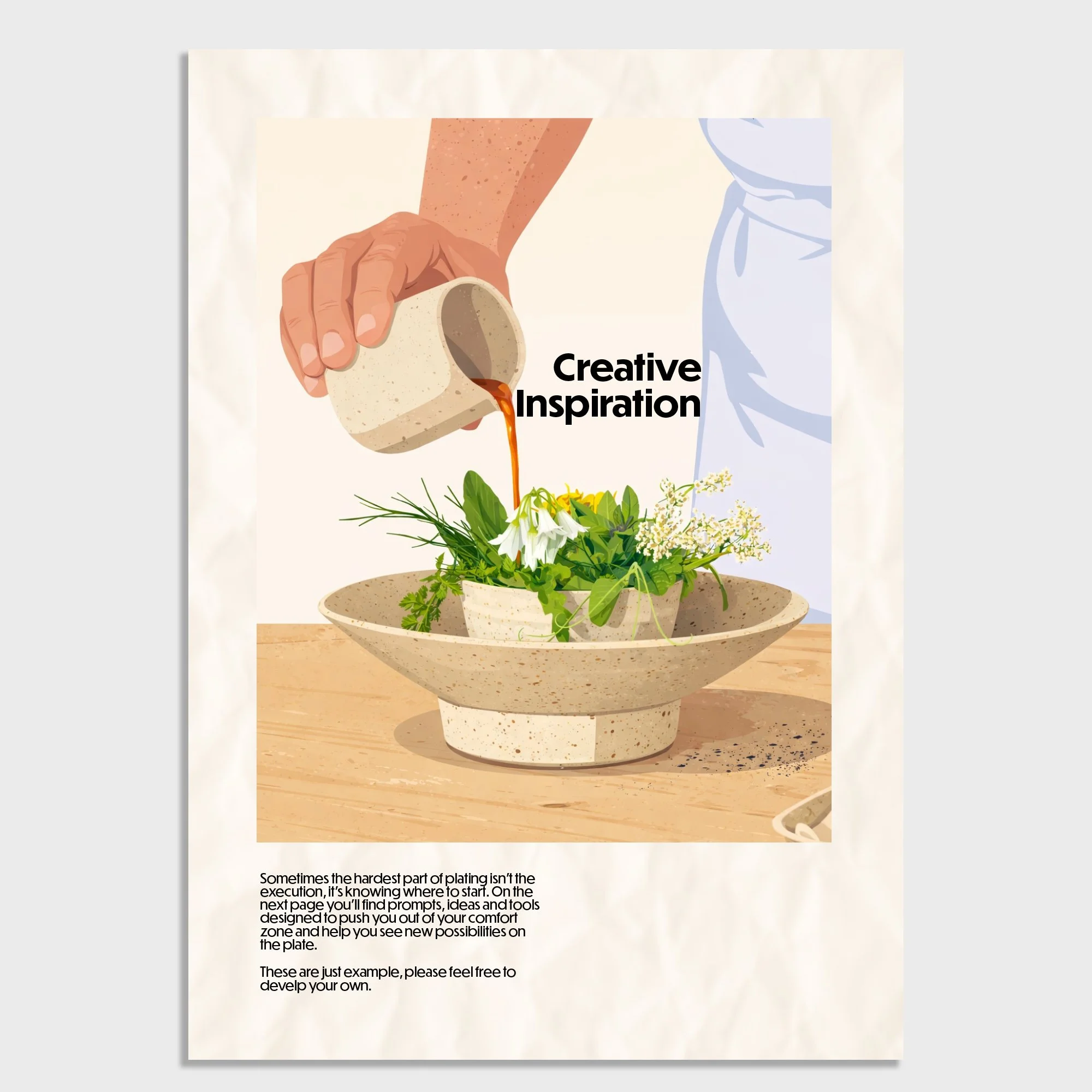
The Training Kit includes structured creative prompts — two-colour challenges, monochrome plates, off-centre layouts, garnish-as-hero exercises. These aren’t random exercises. They are deliberate disruptions of your habits.
They stretch your visual thinking and prevent you from defaulting to the same composition every time.
Critique: Where Real Growth Happens
If there is one habit that accelerates improvement more than anything else, it is critique.
The Self-Critique Checklist and C.R.A.P. framework are structured tools for reflection. Contrast, Repetition, Alignment, Proximity….. these principles allow you to analyse your own work objectively.
Instead of “I think it looks good,” you begin asking:
Is the focal point clear?
Is there enough contrast?
Does repetition create cohesion?
Is alignment guiding the eye?
Are relationships between elements intentional?
This is where plating shifts from instinct to design discipline.
So Which One Do You Need?
If you want to understand plating deeply — the theory, the psychology, the visual language — start with The Plating Gym.
If you want to build consistency, discipline, and structured execution — the Training Kit is your starting point.
Used together, they are powerful. The book expands your thinking. The kit sharpens your doing.
But they are not duplicates. One builds vision. The other builds habit.
Why the Training Kit Exists
Over the years, through Dining Fables and conversations on The Food Envy Podcast, I noticed a consistent pattern. Many chefs and home cooks understood what beautiful plating looked like. They could identify it instantly. But when it came to creating it themselves, they lacked a repeatable system.
The Training Kit is that system.
It turns plating from something you “hope” works into something you design deliberately.
And that shift — from guessing to structuring, from decorating to composing — is what ultimately builds confidence.
Plating isn’t about adding more. It’s about thinking more clearly.
The Plateist Training Kit is simply a tool to help you do exactly that.
Plate with purpose,
Tom